


Trust Signals That Help Shoppers Buy Faster


Most eCommerce conversion advice focuses on getting more people to the store. Trust signals work differently — they determine how many of those people actually buy. A shopper who lands on a product page has already been acquired. The trust gap is what stands between that visitor and a completed order.
According to Senja's research, 73% of visitors bounce without buying even when they're visibly engaged — reading descriptions, viewing multiple product images, spending significant time on the page. They're interested. What's stopping them is a question the page hasn't answered yet: "Is it safe to buy from this store, and will I get what I expect?" Trust signals answer that question — and the faster they answer it, the faster the purchase happens. On Shopify, implementing most of these signals takes hours, not weeks, and the conversion impact is measurable within days of going live.

Why Trust Signals Shorten the Decision Cycle
The psychology behind trust signals is well-documented. When people face uncertainty — which every first-time online purchase involves — they look for signals that others have navigated the same situation successfully. This is Robert Cialdini's social proof principle applied to eCommerce: shoppers use other people's experiences as a proxy for their own predicted experience.
But trust signals do more than reduce anxiety. They compress the deliberation timeline. A shopper who would have spent three days researching before committing can be moved to same-session purchase when the page provides sufficient evidence upfront. The deliberation still happens — it just happens faster because the evidence is already there.
The signals that compress this timeline most effectively aren't the ones that shout the loudest. They're the ones that answer the specific question a hesitant buyer is holding at the exact moment they're holding it. That's why placement matters as much as presence.
Social Proof: The Highest-Impact Trust Signal
Customer reviews are the most effective trust signal available to eCommerce stores. Product pages featuring reviews convert at 3.5x the rate of pages without them (Rebuy Engine, citing industry data). The reason isn't complicated: a review from a real buyer is more credible than any claim the merchant can make about their own product.
![Customer reviews: How to get and use them [+ templates]](https://d1eipm3vz40hy0.cloudfront.net/images/AMER/customerreviewofacompanysonlinecustomerservice.png)
What most stores get wrong about reviews:
- Displaying too few. A product with 8 reviews doesn't build confidence — it raises the question of why so few people have bought it. The total review count matters as much as the average rating. Display the number prominently: "4.6 stars from 847 reviews" signals safety in a way that "4.6 stars" alone doesn't.
- Hiding negative reviews. According to ConvertCart's analysis, customers actively want to read about drawbacks. A suspiciously perfect rating erodes trust faster than a realistic one. A 4.5 with visible critical feedback and brand responses outconverts a 5.0 that looks curated.
- Burying reviews below the fold. Reviews that require scrolling to find are seen only by shoppers who are already interested. Reviews visible near the product title and Add To Cart button catch hesitant shoppers at the decision point.
- Showing only text reviews. Photo and video reviews from real customers in real settings provide the closest substitute for physical product examination. According to Foursixty's analysis of 83 women's apparel brands, UGC galleries and customer imagery consistently drive higher add-to-cart rates than product photography alone.
- Ignoring recency. A wall of reviews from 2021 doesn't reassure a 2025 buyer. Automate post-purchase review requests and filter for recency — reviews less than 90 days old carry significantly more persuasive weight than older ones.
Returns Policy: The Signal Most Stores Place Wrong
A generous returns policy that's buried in the footer is worth almost nothing as a trust signal. The same policy displayed as a single line near the Add To Cart button — "Free returns within 30 days" — removes the "what if it's wrong?" objection at precisely the moment the shopper is deciding whether to commit.
According to McKinsey's research cited by MetricsCart, 65% of US online buyers prioritize easy returns when choosing where to buy. That preference doesn't activate unless the shopper actually sees the policy before checkout. Most stores make customers hunt for this information — which is the equivalent of hiding the main reason not to hesitate.
Return policy copy that converts versus policy copy that doesn't:
| Weak version | Stronger version | Why it converts better |
|---|---|---|
| "See our returns policy" | "Free returns within 30 days, no questions asked" | Answers the question immediately rather than making the shopper click to find the answer |
| "Returns accepted" | "Not the right fit? We'll cover return shipping" | Addresses the specific fear (paying to return) rather than the generic concept of returns |
| "30-day return window" | "30-day money-back guarantee — full refund, no hassle" | "Money-back guarantee" framing removes financial risk perception more directly than "return window" |
| Source: Rework Resources trust signal placement research; Splitbase product page optimization analysis | ||
Security Badges and Payment Trust Signals
Payment security anxiety affects a meaningful share of first-time buyers. According to ConvertCart's research, 18% of shoppers don't trust eCommerce brands with their credit card information. That hesitation doesn't disappear without a visible signal that addresses it — and it's most acute at the moment the shopper is deciding whether to add to cart, not only at checkout.
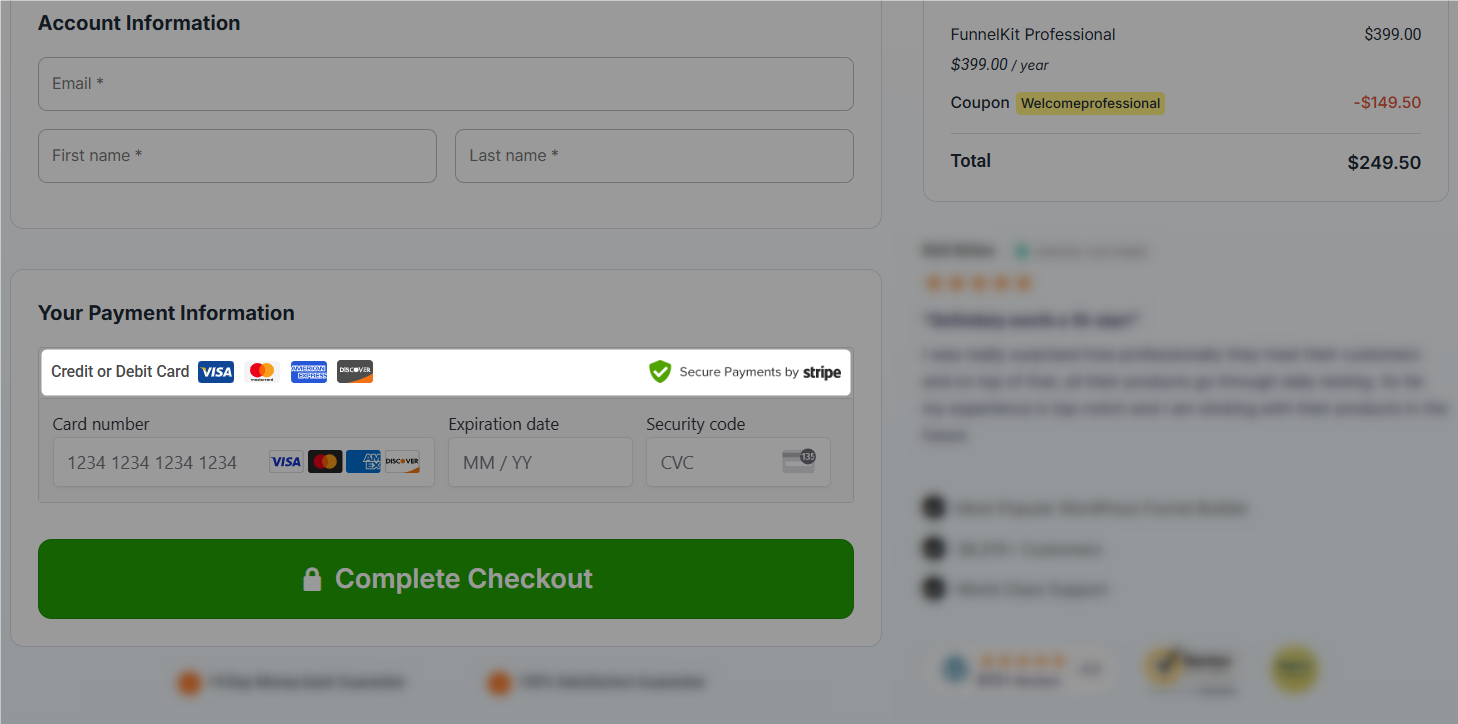
Placement strategy for security signals by page:
- Product page: secure checkout icons (padlock, SSL indicator) and recognized payment logos (Visa, Mastercard, PayPal, Shop Pay, Apple Pay) placed below the Add To Cart button. The shopper doesn't need to enter payment information yet — but seeing familiar payment logos signals that checkout will be normal and protected.
- Cart page: reinforce with a "Secure Checkout" indicator as purchase intent increases. The cart is where financial commitment starts to feel real — trust signals here catch late-stage hesitation.
- Checkout: security badges placed directly adjacent to payment form fields, where the shopper is actively entering sensitive information. According to Rework Resources' trust signal research, this placement is the most critical — maximum anxiety requires maximum reassurance.
A note on badge selection: use recognized logos over generic "100% Secure" text. A PayPal logo, a Shopify Secure badge, or a recognized SSL provider logo transfers credibility from a trusted institution to your store. Generic security text doesn't — it's a claim you're making about yourself, which carries no third-party weight.
Shipping Transparency as a Trust Signal
Shipping information is a trust signal as much as it's a logistics detail. According to Clickpost's 2025 abandonment data, 22% of shoppers abandon because of slow or unclear delivery timelines. The abandonment isn't caused by slow shipping — it's caused by uncertainty about shipping. Stores that communicate delivery expectations clearly convert those shoppers; stores that leave delivery timing vague lose them.
The specificity principle: "Arrives by Thursday" converts better than "3–5 business days," which converts better than "Ships within 1–2 weeks," which converts better than no shipping information at all. Each increase in specificity reduces the uncertainty that causes abandonment.
What to show on the product page, not just at checkout:
- Estimated delivery date (or date range) based on the shopper's location if detectable
- Free shipping threshold if you offer one ("Free shipping on orders over $50")
- Expedited shipping option if available — 54% of online shoppers are willing to pay for faster delivery (McKinsey, cited by MetricsCart)
- Cut-off time for same-day or next-day dispatch ("Order before 2pm for same-day shipping")
For international shoppers, the additional element that moves conversion is landed cost transparency — showing estimated duties and taxes at the product page level rather than revealing them at checkout. International cart abandonment caused by surprise checkout costs is one of the most predictable and preventable conversion failures in eCommerce.
Social Proof Beyond Reviews
Reviews are the most direct form of social proof, but they're not the only one. Several other signals tap into the same psychology — "other people have done this and it worked" — and are particularly useful for newer products without a substantial review base.
Press and media mentions
Featured-in logos from recognizable publications (even regional or niche ones relevant to your category) transfer credibility from the publication to your brand. A coffee equipment brand featured in a respected specialty coffee publication carries more trust weight with their target buyer than any amount of generic marketing copy. According to Rework Resources, the most effective implementation links the press logo to the actual article — transforming a vague "as seen in" claim into verifiable third-party validation.
Customer counts and purchase signals
"Join 12,000+ satisfied customers" or "847 people bought this this week" provide social validation through quantity. These signals work on the same principle as a busy restaurant: visible popularity indicates quality. Real-time signals like "X purchased in the last 24 hours" tap into urgency as well as social proof — but only when they're genuine. False urgency signals erode trust faster than they build it.
Expert endorsements and certifications
For regulated categories — supplements, children's products, skincare, electronics — compliance certifications (FDA registration, CPSC compliance, CE marking) function as essential trust signals. According to Rework Resources' analysis, customers in regulated categories expect compliance and penalize stores that don't display it visibly. These signals primarily prevent negative trust impact rather than creating positive conversion lift, but their absence is a disqualifier for a significant share of buyers.
The Compounding Effect of Multiple Trust Signals
Individual trust signals help. The combination is disproportionately more effective. A shopper who sees strong reviews, a clear returns policy, recognized payment logos, and a specific shipping estimate simultaneously experiences something different from a shopper who sees only one of these: the store feels like it was designed for their confidence, not just optimized for its own revenue.
A trust signal audit checklist for any Shopify product page:
- Star rating and review count visible below product title, above the fold
- At least one UGC or customer photo visible in the review section
- Returns policy as a single line near Add To Cart (not linked to a footer page)
- Shipping estimate or free shipping threshold near Add To Cart
- Recognized payment icons below Add To Cart button
- Secure checkout indicator on cart and checkout pages
- Press mentions or certifications relevant to the product category
- Response to at least one critical review visible in the review section
None of these elements need to be large or visually dominant. A well-designed product page includes them compactly and in context — visible when the shopper needs them, unobtrusive when they don't.
Final Thoughts
Trust signals don't manufacture confidence — they surface evidence that confidence is warranted. The stores that convert at the highest rates aren't the ones running the most promotions or generating the most traffic. They're the ones that have made it easiest for an interested shopper to find the answer to "should I buy this?" without having to look anywhere else.
Every trust signal placed correctly shortens the gap between interest and action. Compounded across all the visitors who arrive interested and leave unconverted, that gap is where most eCommerce revenue is being left on the table.
Building a store that converts consistently on Shopify means treating trust not as a brand-building exercise but as a conversion mechanic — one where the right signal, in the right place, at the right moment in the shopper's decision, is the difference between a bounce and a sale.
FAQ
Which trust signal has the biggest impact on conversion?
Customer reviews, when displayed correctly — with total count visible, recency prioritized, and UGC images included. Product pages with reviews convert at 3.5x the rate of pages without them. If you can only implement one trust signal, a well-structured review section near the top of the page delivers the most measurable lift.
Do security badges actually increase conversion, or are they just decorative?
They matter most for first-time buyers who don't recognize your brand. For stores with high repeat purchase rates or strong brand recognition, the impact is smaller. For stores converting a significant share of new visitors — especially from paid traffic — visible payment logos and secure checkout indicators measurably reduce payment-related abandonment.
How should I handle negative reviews?
Display them and respond publicly. A brand that responds to critical reviews with accountability and solutions builds more trust than one that shows only positive feedback. Shoppers read negative reviews specifically to understand how the brand handles problems — a thoughtful public response turns a liability into a trust signal.
Can I add too many trust signals to a product page?
Yes. A page cluttered with badges, guarantees, and urgency signals reads as anxious rather than trustworthy. The goal is to answer the shopper's specific questions at the moment they arise — not to display every available signal simultaneously. Audit which questions your shoppers actually have and place only the signals that answer those questions.


