


Building Adaptive Personalization Systems for Modern Ecommerce


As ecommerce operations mature, personalization evolves from a messaging tactic into a decision-making system. Early-stage approaches—manual segments, fixed journeys, and campaign-level customization—offer short-term gains but fail to adapt as customer behavior grows more complex.
Modern ecommerce environments are defined by variability. Customers move fluidly between research, consideration, purchase, and disengagement. These movements do not follow linear paths, and systems that rely on predefined assumptions struggle to remain relevant.
This reality has led many brands to rethink personalization from the ground up. Rather than optimizing individual messages, they invest in adaptive systems capable of interpreting behavior continuously and responding appropriately. Platforms like Klaviyo have become foundational to this approach.

Why Personalization Must Be Designed as a System
Personalization often fails because it is treated as an output problem rather than an input problem. Teams focus on copy, timing, or creative variations without addressing how decisions are made upstream.
In practice, every personalized message reflects a series of system-level choices:
- Which data points are considered signals
- How those signals are weighted or prioritized
- What conditions trigger a response
- Which channel delivers the response
If these decisions are fragmented across tools or maintained manually, personalization becomes fragile. As scale increases, inconsistency replaces relevance.
A system-first approach centralizes decision logic, allowing personalization to scale without proportional increases in effort.
The Limitations of Predefined Customer Journeys
Traditional personalization frameworks rely heavily on predefined customer journeys. These models assume that customers move through predictable stages in a fixed order.
While useful for conceptual planning, journey maps fail to capture real-world behavior. Customers frequently pause, regress, or skip stages entirely. Static systems struggle to interpret these deviations.
As a result, brands encounter several recurring issues:
- Messages arrive out of context
- Customers receive conflicting signals
- Automation becomes difficult to debug
These failures are not execution errors. They are architectural mismatches between static design and dynamic behavior.
Behavioral Signals as the Core Decision Layer
Adaptive personalization systems prioritize behavior over classification. Instead of assigning customers to fixed segments, they observe actions and infer intent dynamically.
Behavioral signals include both explicit actions and implicit patterns:
- Frequency and depth of product exploration
- Time between sessions and purchases
- Engagement velocity across channels
- Response decay to previous messages
These signals are time-sensitive. Their relevance diminishes quickly, which makes real-time interpretation essential.
Systems designed around behavior continuously reassess customer state. Messaging decisions reflect current context rather than historical labels.
Unifying Inputs Into a Single Interpretive Layer
Behavioral signals lose meaning when isolated. Fragmented data sources produce partial views that distort decision-making.
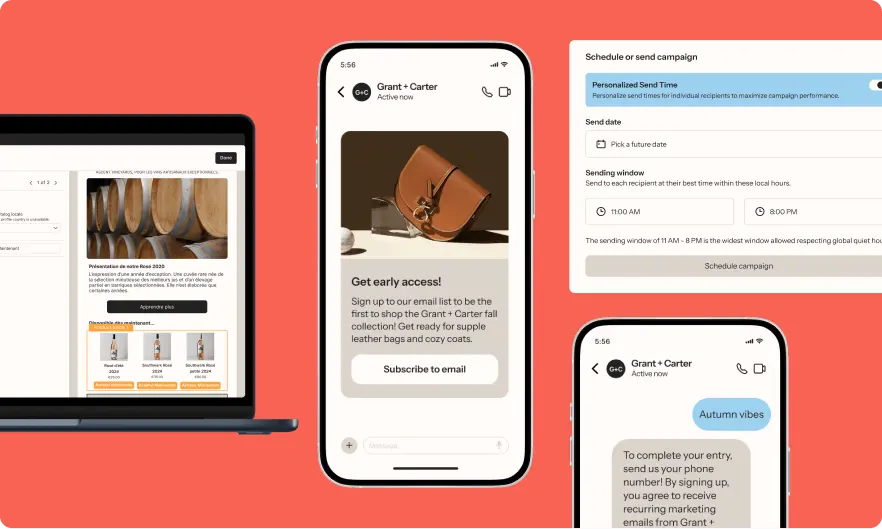
An effective personalization system requires a unified interpretive layer where all relevant inputs converge. This includes transactional history, engagement data, browsing behavior, and channel interactions.
Platforms like Klaviyo consolidate these inputs into continuously updated customer profiles. Decision logic operates on this unified view rather than disconnected events.
Unified data enables systems to:
- Detect intent shifts earlier
- Prevent redundant or contradictory messages
- Coordinate responses across channels
This coherence is critical for maintaining relevance as volume increases.
Decision Flow Over Campaign Planning
Campaign planning emphasizes what to send and when. Decision flow design emphasizes how the system decides.
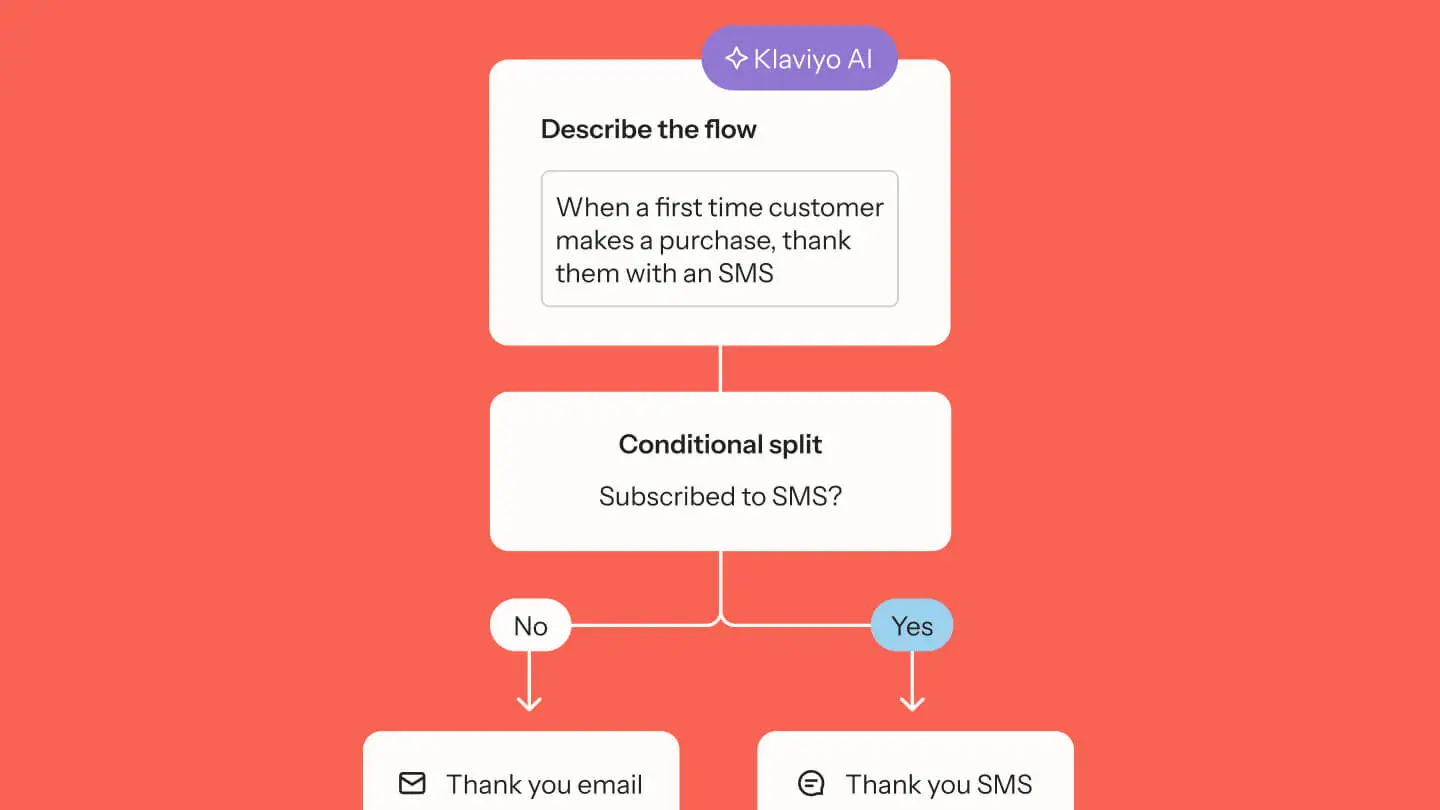
Instead of scheduling messages, adaptive systems define conditional logic:
- If intent increases, escalate engagement
- If engagement decays, reduce frequency
- If conversion occurs, transition state
This logic operates continuously, adjusting output without manual intervention.
| Campaign-Centric Model | Decision-Flow Model |
|---|---|
| Fixed send schedules | Event-driven responses |
| Manual optimization | Continuous adaptation |
| Volume-focused | Relevance-focused |
As complexity grows, decision-flow systems remain manageable because logic scales independently of message count.
Email and SMS as Execution Layers
In adaptive systems, channels are execution layers rather than strategic drivers. Email and SMS deliver responses determined by upstream logic.
Email supports depth and continuity. It provides space for explanation, education, and reinforcement. SMS delivers immediacy, reaching customers during moments where timing influences outcomes.
When both channels operate under shared decision logic, they reinforce rather than compete.
- Email maintains narrative coherence
- SMS punctuates key moments
- Together, they guide progression
Channel effectiveness becomes a function of timing and context rather than frequency.
Lifecycle States as Dynamic Conditions
Lifecycle marketing is most effective when states are treated as conditions, not labels. Customers enter and exit states based on behavior rather than elapsed time.
Common lifecycle conditions include:
- Post-purchase confidence building
- Momentum toward repeat purchase
- Early disengagement indicators
- Long-term loyalty reinforcement
Adaptive systems monitor these conditions continuously, triggering transitions automatically.
This approach reduces the need for manual segmentation while preserving strategic intent.
AI as a Prioritization Mechanism
As signal volume increases, prioritization becomes the primary challenge. AI assists by identifying which signals require attention and which can be ignored.
Rather than replacing human judgment, AI supports it by surfacing probabilities, trends, and anomalies.
AI-driven systems help teams:
- Identify high-impact opportunities
- Detect churn risk earlier
- Optimize timing at individual levels
This allows human effort to focus on system refinement rather than constant monitoring.
Preserving Control Through System Design
Automation often raises concerns about loss of control. In well-designed systems, the opposite is true.
Control shifts from execution to architecture. Teams manage thresholds, rules, and priorities rather than individual sends.
This architectural control enables:
- Consistent customer experience
- Predictable system behavior
- Faster iteration without disruption
Clarity replaces micromanagement.
Why Relevance Outperforms Volume
As attention costs rise, volume-based strategies become increasingly inefficient. Relevance, by contrast, compounds.
Messages aligned with intent require fewer sends and fewer incentives. Over time, relevance builds trust, which improves efficiency across the system.
Adaptive personalization systems are designed to maximize relevance rather than reach.
Closing Perspective: Adaptation as Competitive Advantage
Modern ecommerce competition is defined by adaptability. Brands that respond quickly to behavioral change gain an enduring advantage.
Personalization systems built on unified data, behavioral interpretation, and adaptive automation enable this responsiveness.
Platforms like Klaviyo support this evolution by providing the infrastructure required for system-level personalization.
In environments where customer behavior never stands still, adaptive systems are not optional—they are essential.