


Klaviyo Setup Checklist for Ecommerce: Automations, Segments, and ROI

In ecommerce, email is rarely the problem. Stores struggle when email is disconnected from what customers are doing. When messages are generic, customers ignore them. When timing is off, conversion drops. When there is no post-purchase journey, retention stalls.
Klaviyo is designed to solve those issues because it is built around customer data and automation. With Klaviyo, you can turn store behavior into messaging that feels relevant—without manually building every campaign from scratch.
This guide is written as a practical checklist. If you want to get to “repeat purchase growth” fast, follow the sections in order: setup foundation, launch the core flows, add a small set of segments, then run a weekly optimization routine that keeps improving results.
Step 1: Understand What Klaviyo Does Best
Klaviyo is a marketing automation platform built for ecommerce. Its “native strength” is event-driven lifecycle marketing: flows that trigger from customer actions and evolve with customer intent.
That is why stores use Klaviyo for:
- welcome journeys that convert subscribers into buyers
- abandonment recovery that captures high-intent revenue
- post-purchase education that increases second purchases
- review request sequences that grow social proof
- win-back flows that re-activate customers before churn becomes permanent
In short, it helps your marketing behave like a system rather than a series of one-off campaigns.
Step 2: Build the Foundation (Before You Build Flows)
Flows only work when the data layer is clean. Before you design messages, ensure the basics are in place.
Foundation checklist
- Confirm store events: view, add to cart, begin checkout, purchase are tracking correctly.
- Define primary goals: first purchase conversion, second purchase rate, reactivation rate.
- Create a basic naming system: so flows and segments stay organized as you grow.
- Set expectations for frequency: decide how often you want campaigns to go out per week.
Step 3: Prioritize Features That Drive Revenue
Not every feature deserves attention at the beginning. Start with the tools that have the strongest impact on conversion and retention.
Forms for list growth
Collecting subscribers is easy. Collecting high-intent subscribers is harder. Strong form strategy typically means:
- a clear value promise (helpful benefit, early access, bundle) rather than only a discount
- minimal fields to reduce drop-off
- preference capture later through follow-up emails
Flow builder (automation)
Automation is where most ecommerce email revenue comes from. Klaviyo’s flow builder helps you create triggered sequences that run continuously and compound over time.
Segmentation (relevance at scale)
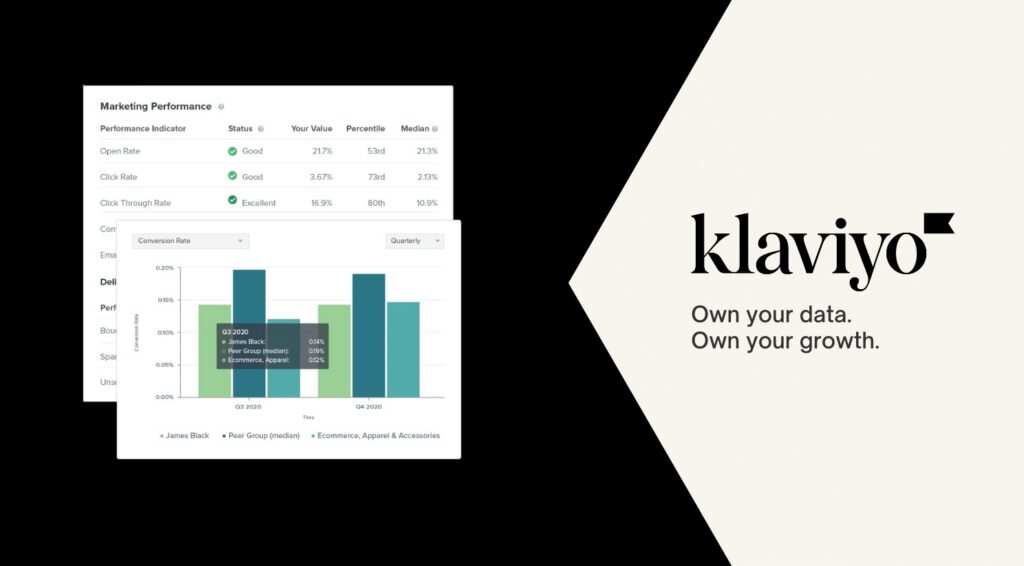
Segmentation is the difference between “broadcasting” and “personalizing.” Start with behavior-based segments, because they reflect intent.
Reporting (visibility into ROI)
Good reporting keeps you from guessing. It should connect flows and campaigns to revenue per recipient, conversion, and repeat purchases.
Step 4: Launch the Core Flows (In This Order)
Trying to build ten flows at once usually leads to incomplete setups and unclear results. Launch five core flows first. They cover the lifecycle that matters most.
Flow 1: Welcome series
Goal: subscriber → first purchase.
- Email 1: brand promise + what problem you solve
- Email 2: best sellers or curated “start here” picks
- Email 3: proof (reviews, UGC, outcomes)
- Email 4: gentle nudge or perk (optional)
Flow 2: Abandoned cart
Goal: recover shoppers who showed intent.
- Message 1: reminder with a direct link back
- Message 2: benefits + objection handling
- Message 3: proof or light offer (optional)
Flow 3: Abandoned checkout
Goal: recover the highest-intent drop-offs.
Checkout abandonment often needs trust signals: shipping clarity, returns, guarantees, payment security, and short proof snippets.
Flow 4: Post-purchase education
Goal: first purchase → second purchase.
- how to use / setup / routine guidance
- what to expect and how to get the best results
- recommended companion items that improve outcomes
Flow 5: Win-back
Goal: re-activate customers based on inactivity windows.
- 30 days: relevance reminder + curated picks
- 60 days: “new in your category” + updated proof
- 90 days: last attempt (small incentive only if necessary)
These are the flows many teams build first when adopting Klaviyo, because they align directly with revenue milestones.
Step 5: Create a Small Segmentation System
Keep segmentation simple in the beginning. You want segments that change how you message, not segments that exist only because they are possible.
- VIP: high spenders, highest lifetime value customers
- First-time buyers: one purchase within a recent window
- Repeat buyers: 2+ purchases
- Inactive customers: no purchase in 60–90 days
- Category interest: repeated browsing in one category
Once these segments are stable, you can add nuance (discount sensitivity, engagement level, product affinity), but the core system already improves relevance dramatically.
Step 6: Run a Weekly Optimization Routine
Set a 30–45 minute weekly review. You do not need complex analysis to improve results; you need consistency.
Weekly review checklist
- Which flow produced the most revenue per recipient?
- Which flow has the biggest drop-off (clicks, conversions)?
- Which segment responded best to recent campaigns?
- Are unsubscribes rising (a sign of too much promo or low relevance)?
High-impact improvements
- rewrite subject lines to be more specific and benefit-driven
- make emails shorter and easier to scan
- add proof where hesitation is likely (shipping, returns, reviews)
- adjust timing based on customer behavior
Step 7: Avoid These Common Traps
- Over-emailing promotions: your list becomes discount-trained.
- Skipping post-purchase: you lose the second purchase opportunity.
- Using one segment for everyone: relevance collapses.
- Discount dependency: margin shrinks while expectations rise.
- Ignoring deliverability: list health determines long-term ROI.
FAQ
Can Klaviyo work for a small ecommerce brand?
Yes. Many small stores start with a few key flows and basic segmentation, then expand as revenue grows.
What are the top three flows to launch first?
Welcome series, abandoned cart/check-out recovery, and post-purchase education. Those create the biggest compounding impact.
Should I rely on discounts to make flows work?
Not as your default. Discounts can be useful selectively, but education, proof, and clarity usually outperform constant markdowns over time.
What metrics matter most for retention?
Second purchase rate, time-to-second order, revenue per recipient (flows), and reactivation rate for inactive segments.
Final Thoughts
Klaviyo is most effective when it becomes your lifecycle infrastructure: a set of flows and segments that keep messages aligned with customer behavior. Start small, launch the core automations, measure weekly, and improve in steady iterations.
If you want an ecommerce platform designed for personalization and automation, you can explore Klaviyo and build a retention system that drives repeat purchases without relying on constant ads.
Building retention revenue with Klaviyo becomes far more consistent when you combine behavior-based segmentation, a strong flow foundation, and reporting that ties your messaging directly to customer actions and repeat orders over time.