


How To Set A BFCM Free-Shipping Threshold

Free shipping sounds like an easy Black Friday offer. Customers love seeing it, and merchants hope it encourages bigger orders.
But free shipping is not free for the store. A customer may pay nothing for delivery while the merchant still covers carrier charges, packaging, handling, and fulfillment costs.
A poorly chosen threshold can turn a successful BFCM weekend into a margin problem. A cart worth $45 might qualify for free shipping even though its profit barely covers delivery.
For merchants who want to build a Shopify store with smarter shipping offers, the goal is to choose a threshold that encourages larger carts without giving away too much profit.
This guide explains how to calculate a BFCM free-shipping threshold, configure it on Shopify, and test whether the offer actually improves order profitability.
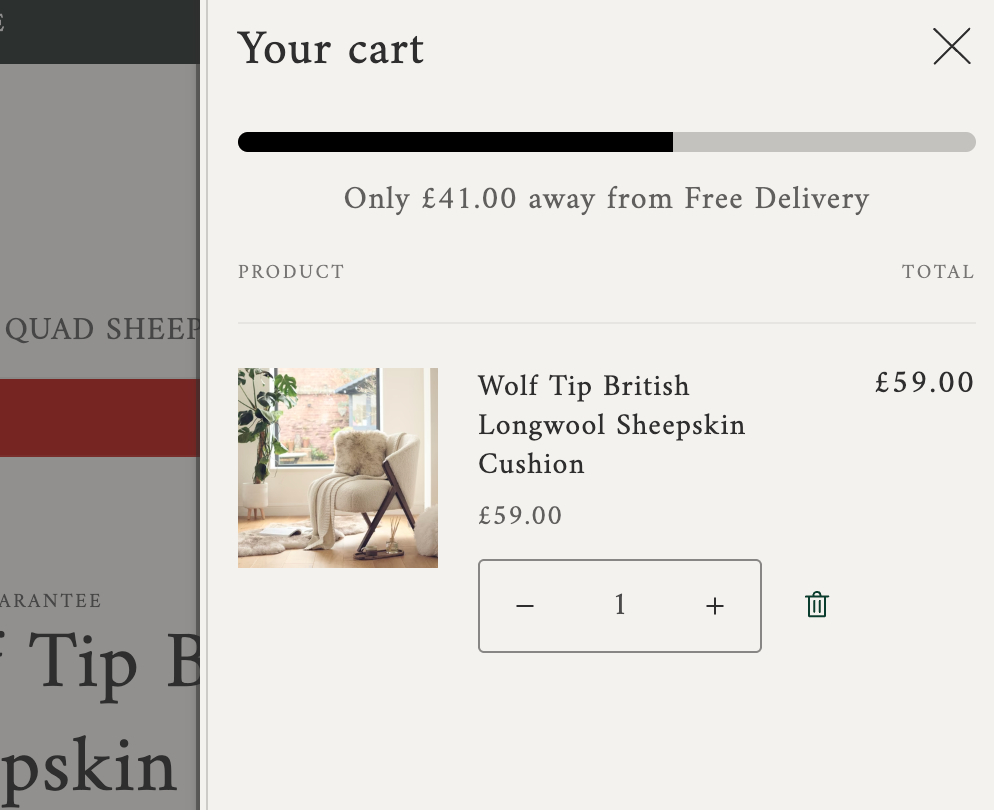
Image source: Flair Consultancy — Free Shipping Progress Bar Guide.
Why Free Shipping Can Hurt BFCM Margins
Free shipping can help reduce buying friction, but it also moves a cost from the customer to the merchant. During BFCM, that cost may be combined with product discounts, advertising expenses, and unusually high order volume.
Shipping is free for shoppers, not merchants
When a store offers free delivery, somebody still pays the carrier. Usually, that cost is absorbed by the business or accounted for in its product pricing.
Shopify's free-shipping guidance recommends reviewing product margins and delivery costs before selecting a threshold (Source: Shopify, Free Shipping: 8 Strategies To Boost Sales in 2026).
Discounts shrink the margin available
Consider a product priced at $50 with a $30 product cost. Before discounts, it produces $20 in gross profit.
A 20% BFCM discount reduces revenue to $40. Assuming the product cost stays unchanged, gross profit drops to $10 before shipping, payment fees, packaging, and other expenses.
If delivery costs $8, very little remains to cover everything else. Adding free shipping to an already-discounted order can quickly weaken contribution margin.
High order volume magnifies shipping losses
A shipping subsidy that looks small on one order can become expensive across hundreds or thousands of orders.
For example, absorbing an additional $3 on 1,000 orders creates $3,000 in extra cost. Higher revenue does not automatically make those orders more profitable.
What Makes a Free-Shipping Threshold Profitable?
A profitable threshold depends on actual order behavior and costs, not an arbitrary number such as $50 or $75. Three inputs matter most: order value, contribution margin, and delivery cost.
Average order value and median order value
Average order value (AOV) shows the typical revenue per order. Median order value shows the middle point of your order distribution.
Both are useful because a few unusually large orders can push AOV upward. Shopify recommends considering AOV or median order value when setting a threshold that encourages shoppers to add items (Source: Shopify).
If most customers spend around $40, a $50 or $55 threshold may feel more achievable than $100. However, the final choice still depends on profit and customer response.
Gross margin and contribution margin
Gross margin measures revenue remaining after the cost of goods sold. Contribution margin goes further by accounting for relevant variable costs.
For a BFCM promotion, merchants should account for discounts, packaging, payment fees, variable fulfillment, shipping subsidies, and expected returns.
A threshold that covers delivery using gross profit might still fail after those other costs are included.
Parcel cost, packaging, and fulfillment
Shipping cost changes with destination, weight, parcel dimensions, and service level. A second product can increase cart value while also increasing shipping expense.
Heavy bottles, fragile products, large gift boxes, and oversized items can cost more to ship than lightweight accessories.
Before you plan BFCM shipping promotions on Shopify, calculate actual fulfillment costs for your common order types.
How to Calculate Your Free-Shipping Threshold
Start with your existing order economics. Shopify's free-shipping guide uses AOV, average shipping cost, and gross margin to estimate how much additional cart value can help cover delivery costs.
Start with your normal AOV
Assume a store has the following figures:
- Average order value: $40
- Average delivery cost: $8
- Gross product margin: 40%
These are hypothetical numbers for illustration, not industry benchmarks.
Begin by proposing a threshold slightly above the current order value. Then calculate the additional gross profit that a qualifying cart might generate.
Estimate profit from the extra cart value
Use this simplified calculation:
Extra gross profit = (Free-shipping threshold - Current AOV) × Gross margin
If the threshold is $55, the increase from the $40 AOV is $15.
At a 40% gross margin, those extra sales produce approximately $6 in additional gross profit. If shipping costs $8, that incremental profit covers $6 of the shipping bill.
This leaves $2 of shipping cost not covered by the additional gross profit, before considering any changes in fulfillment, discounts, or payment costs (Source: Shopify, Free Shipping Guide).
Compare threshold scenarios before launch
Do not test only one number. Compare several possible thresholds using the same assumptions.
| Free-shipping threshold | Extra cart value above $40 AOV | Additional gross profit at 40% | Shipping not covered by added gross profit |
|---|---|---|---|
| $45 | $5 | $2 | $6 |
| $50 | $10 | $4 | $4 |
| $55 | $15 | $6 | $2 |
| $60 | $20 | $8 | $0 |
At $60, the incremental gross profit theoretically covers the $8 shipping cost. That does not guarantee the entire order is profitable.
The calculation assumes shoppers genuinely add more products, the additional items maintain a 40% margin, and shipping cost remains $8. It also excludes other variable expenses.
A higher threshold can improve unit economics but may discourage purchases if customers feel the target is too far away.

Image source: Vinkit — Vinted Parcel Relay Shipping Guide.
Free-Shipping Threshold Examples for BFCM
Different product categories need different approaches. A threshold that works for lightweight accessories may not make sense for furniture, electronics, or heavy household goods.
Low-ticket products
Stores selling socks, accessories, candles, stationery, or small beauty items can use free shipping to encourage multi-item orders.
If customers normally spend $25, the threshold might encourage an additional accessory or multipack.
The challenge is ensuring the extra items generate enough profit to cover shipping. Adding low-margin products just to reach the threshold can undermine the offer.
Mid-priced products and bundles
Stores selling apparel, gift sets, skincare, or home accessories may benefit from thresholds near common two-item basket values.
For example, a shopper buying a $48 product might consider adding a useful $15 accessory to unlock free standard shipping at $60.
Bundles can work especially well when the additional product complements the original purchase rather than feeling like unnecessary filler.
Heavy or expensive-to-ship products
Bulky products need more caution. Free shipping on furniture, weighted equipment, large pet supplies, or fragile items can create substantial delivery costs.
These products may need different shipping profiles, separate delivery options, or exclusions from the promotional offer.
A single storewide threshold should not force expensive shipping economics onto every product category.
How to Set Free Shipping on Shopify
Shopify supports free shipping through shipping rates and shipping discounts. The correct setup depends on whether the offer should apply automatically to a shipping zone or market, or only to eligible customers and promotions.
Create order-value shipping rates
For stores using shipping profiles, go to Settings > Shipping and delivery. Open the relevant shipping profile and configure the rate for the destination zone.
Set a paid standard shipping option below your threshold and a free rate for qualifying orders.
Shopify is gradually moving some stores to shipping options by market. In the newer experience, eligible merchants can go to Markets > select market > Shipping, add a shipping option, and configure order amount ranges or activate free shipping over a minimum order amount (Source: Shopify Help Center).
Check which interface your store uses before following setup instructions.
Configure free shipping discounts
For promotional eligibility, go to Discounts > Create discount > Free shipping.
Shopify supports discount codes and automatic free-shipping discounts. Merchants can set minimum purchase amounts, eligible countries or markets, customer eligibility, active dates, and discount combination rules (Source: Shopify Help Center).
This can be useful when you want a BFCM-only offer or a promotion limited to specific customer groups.
Test eligibility across shipping markets
Review the shipping zones, markets, products, and fulfillment locations covered by each rate.
If products ship from separate profiles or locations, Shopify may combine applicable shipping rates. Test mixed carts so customers are not unexpectedly charged for part of an order (Source: Shopify Help Center).
When you set up Shopify free-shipping rules, test checkout with actual destination addresses, discounted products, and different cart values before launching the campaign.
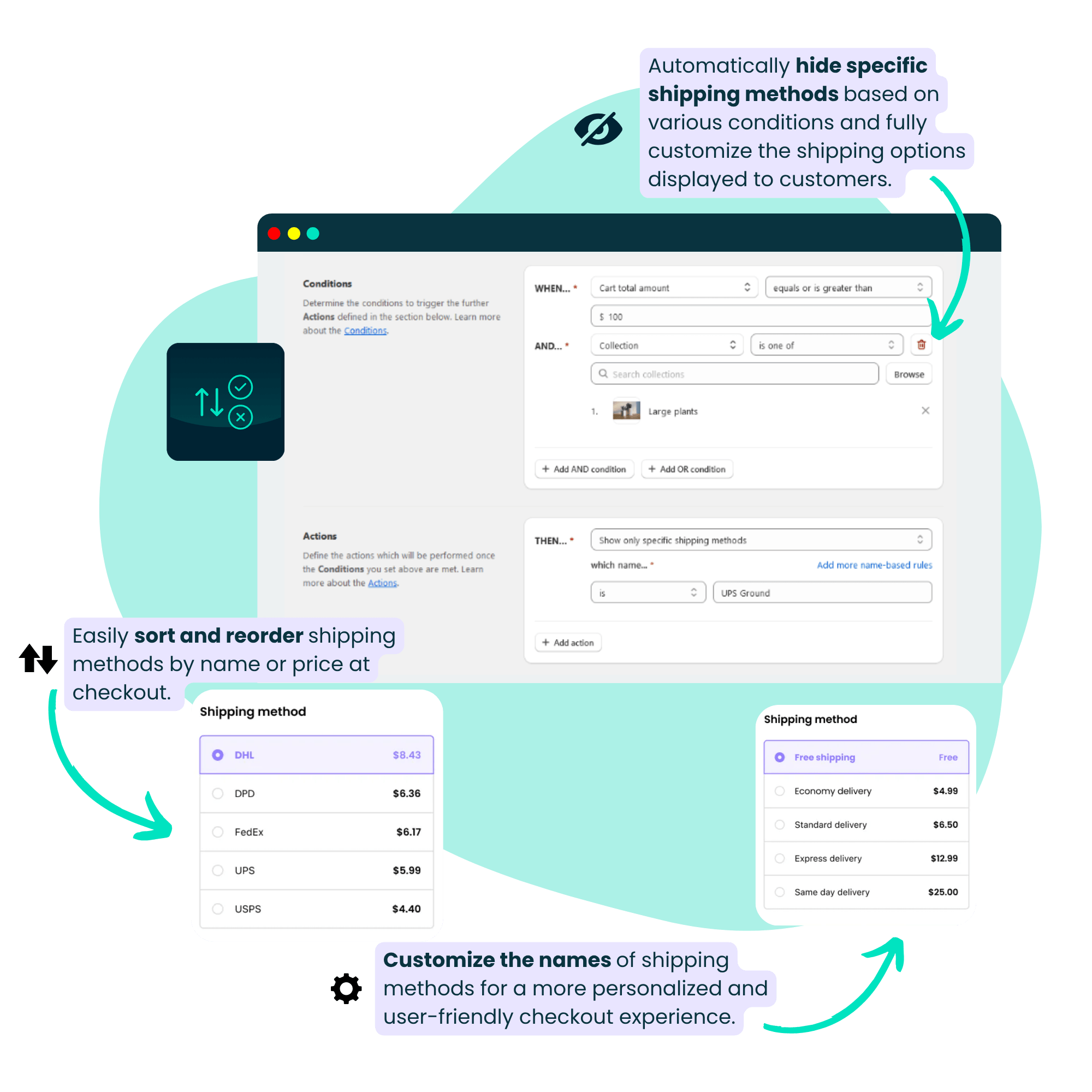
Image source: Octolize — Shopify Hide & Sort Shipping Rates. Third-party app illustration, not Shopify's native shipping settings screen.
Partnered with Shopify: This guide includes links to Shopify for merchants who want to create more controlled shipping offers, test BFCM promotions, and protect profit margins.
Prevent Discounts from Breaking the Threshold
BFCM free-shipping rules can fail when merchants forget how other discounts affect cart value. A customer might appear to qualify before the discount is applied but fall below the threshold afterward.
Check cart values after product discounts
Shopify states that price-based shipping rates use the discounted cart total before tax. Its free-shipping discounts also evaluate minimum purchase requirements using discounted product prices when compatible discounts combine (Source: Shopify Help Center).
For example, imagine a customer has $70 in products and the store offers free shipping above $60.
A 20% product discount reduces the eligible merchandise value to $56. The customer may no longer qualify for free shipping, even though the original cart value was $70.
This matters when displaying free-shipping progress bars or creating product-page messages. The message should reflect the same qualifying value used at checkout.
Control free shipping combinations
Shopify allows eligible product and order discounts to combine with free-shipping discounts when the relevant combination settings permit it.
Only one shipping discount can apply to the same order, although several eligible product and order discounts may also apply (Source: Shopify Help Center).
Test scenarios such as a percentage-off promotion, VIP discount, bundle offer, and free shipping. The customer should receive the intended offer without creating unexpected margin losses.
Exclude expensive shipping services
Shopify's free-shipping discount settings include an option to exclude shipping rates above a specified amount.
This can help prevent a free-shipping discount from covering an expensive delivery option.
That setting is based on the shipping rate amount, not the order minimum. Merchants should distinguish the two when configuring their offer (Source: Shopify Help Center).
How to Encourage Shoppers to Reach the Threshold
Once the threshold is profitable, the next challenge is helping customers reach it naturally. The best approach makes the offer visible without pressuring shoppers to buy irrelevant products.
Show free-shipping progress in the cart
A message such as "You're $12 away from free delivery" tells the customer exactly what remains.
This works best when the amount updates correctly after product changes, discount applications, and cart adjustments.
The progress bar should never promise free shipping when the customer's destination or selected products are ineligible.
Recommend useful add-on products
Recommend products that complement the item already in the cart. A skincare purchase might pair with a refill, while a gift purchase might pair with wrapping or a related accessory.
The ideal add-on is useful to the shopper and generates enough additional contribution profit to justify the shipping incentive.
Avoid unnecessary discount stacking
If a customer already receives 25% off, adding another aggressive discount simply to help them reach free shipping may weaken the economics further.
Useful add-ons and carefully designed bundles can be a better way to raise cart value without cutting the price of every item.
Merchants can create a Shopify store with clearer cart incentives while checking that offers remain profitable after discounts and fulfillment costs.
When You Should Not Offer Free Shipping
Free shipping should be a strategic choice, not a mandatory offer. Some products, orders, and destinations make the cost difficult to justify.
Low-margin product categories
Products with very little gross profit may not generate enough contribution to absorb shipping, especially after BFCM markdowns.
Consider paid shipping, smaller discounts, or higher minimum values for those categories instead of forcing every SKU into the same promotion.
Heavy or oversized shipments
Large and heavy products may have delivery costs that rise much faster than cart value.
For those orders, weight-based shipping, calculated rates, or category-specific policies may be more sustainable.
Expensive international destinations
International shipping rates can vary significantly by market, carrier, weight, customs requirements, and service speed.
A domestic free-shipping promotion should not automatically apply globally. Keep regional shipping economics separate, and communicate restrictions before checkout.
A BFCM Free-Shipping Setup Checklist
Before launching your BFCM free-shipping promotion, review both customer experience and profitability. A good threshold should work consistently across product pages, the cart, checkout, and fulfillment.
Margin calculation checklist
- Calculate normal AOV and median order value.
- Measure average and high-end delivery costs.
- Review product margins after BFCM discounts.
- Include packaging, payment fees, and variable fulfillment costs.
- Estimate contribution profit at several threshold levels.
- Check whether extra items increase shipping weight or parcel size.
Shipping rule configuration checklist
- Confirm the correct shipping profiles or market options.
- Set the minimum order value accurately.
- Review eligible products, locations, and destinations.
- Check how discounts change qualifying cart value.
- Review discount combination permissions.
- Exclude expensive delivery services when appropriate.
- Set BFCM start and end dates for promotional discounts.
Mobile cart and checkout testing checklist
- Test carts just below and above the threshold.
- Test carts before and after percentage discounts.
- Test mixed-product and multiple-profile orders.
- Check cart progress messaging on mobile.
- Verify shipping rates with different customer addresses.
- Check delivery options, exclusions, and policy wording.
- Confirm that the final margin works for qualifying orders.
Shopify recommends testing shipping options before launch because customers see only the rates applicable to their order and destination (Source: Shopify Help Center).
When you prepare your Shopify store for BFCM, shipping should be tested as carefully as product discounts and checkout conversion.
What to Measure during and after BFCM
The threshold should not be considered successful simply because more orders qualify for free shipping. The real test is whether the promotion improves profitable customer behavior.
Track AOV and qualifying order share
Monitor average order value, median order value, and the percentage of orders qualifying for free shipping.
If almost every order already exceeds the threshold without adding products, the offer may be giving away shipping costs without creating meaningful incremental sales.
Compare contribution profit per order
Track net merchandise revenue, COGS, discounts, shipping revenue collected, carrier costs, packaging, payment fees, and fulfillment expenses.
Compare qualifying orders against similar orders before the promotion. AOV growth is useful, but contribution profit is a stronger measure of economic success.
Review cart behavior and delivery complaints
Watch for shoppers abandoning checkout just below the threshold, confusion about discount eligibility, and unexpected shipping charges.
Use those findings to improve cart messaging, shipping terms, product recommendations, and next year's BFCM threshold.
Final Thoughts
A profitable BFCM free-shipping threshold is not simply a round number placed above the average cart value. It is a decision based on product margin, delivery expense, buying behavior, and the real profit remaining after fulfillment.
Shopify merchants should calculate several threshold scenarios, account for discounts, review shipping destinations, and test cart eligibility before launching the offer.
The best threshold encourages shoppers to buy more useful products while leaving the business with healthier contribution profit. Free shipping should support long-term profitability, not just make the BFCM revenue number look bigger.
FAQ
What is a good free-shipping threshold for BFCM?
A good threshold is usually close enough to your normal AOV or median order value to encourage additional purchases, but high enough to help cover delivery costs. Calculate actual margins, shipping expenses, and contribution profit before choosing the final amount.
Can Shopify offer free shipping above a minimum order?
Yes. Shopify supports free shipping through order-value shipping rates and free-shipping discounts with minimum purchase requirements. The available settings depend on your store's shipping configuration and markets (Source: Shopify Help Center).
Do discounts affect Shopify free-shipping eligibility?
Yes. Shopify price-based shipping rates use the discounted cart value before tax. Free-shipping discounts also count discounted product prices when combined with eligible discounts. Merchants can set up free-shipping offers on Shopify and test discounted carts to confirm eligibility before BFCM.
We only recommend tools we've tested and trust. This post may include affiliate links, meaning we may earn a commission if you choose to purchase - at no extra cost to you.


